Figuring out whether to repair or replace your HVAC is a puzzle that every homeowner faces sooner or later. Most people are shocked to learn that proactive maintenance can extend an HVAC system’s life by up to 40%, saving big over time. Yet the real surprise is how those savings can vanish if you miss the signs that it’s time to upgrade. The smartest choice is rarely just about the cheapest fix today. It’s about knowing which tells mean your system is costing you comfort and cash in the long run.
Table of Contents
- Defining Hvac Repair And Replacement: Key Differences
- Why Choosing Between Repair And Replacement Matters
- Factors Influencing The Decision: Cost, Efficiency, And Age
- Understanding The Lifespan Of Hvac Systems: Repair Vs Replace
- Real-World Scenarios: When To Repair And When To Replace
Quick Summary
| Takeaway | Explanation |
|---|---|
| Evaluate repair costs carefully | If repair costs exceed 50% of replacement, consider replacing the system instead. |
| Consider system age for replacement | Systems older than 10-15 years may be less efficient and more prone to failures, making replacement advisable. |
| Assess long-term energy savings | Upgrading to a new, efficient HVAC system can significantly reduce energy bills and provide comfort. |
| Monitor performance indicators | Look for rising energy bills and inconsistent temperatures as signs that repair or replacement is needed. |
| Understand warranty and rebates | Checking warranty status and available energy efficiency rebates can influence your financial decisions. |
Defining HVAC Repair and Replacement: Key Differences
Understanding the nuanced differences between HVAC repair and replacement represents a critical decision for homeowners and business owners managing their heating, ventilation, and air conditioning systems. These two approaches fundamentally address system performance but involve distinctly different strategies, costs, and long-term implications.
The Essence of HVAC Repair
HVAC repair involves targeted interventions to restore a system’s functionality by fixing specific components or addressing localized issues. Technicians diagnose and resolve problems such as malfunctioning compressors, refrigerant leaks, electrical connections, or worn-out parts. Repairs are typically shorter-term solutions designed to extend equipment life and restore immediate operational capacity.
Key considerations for HVAC repair include:
- Addressing specific mechanical or electrical failures
- Restoring system performance without complete system overhaul
- Generally lower upfront costs compared to full replacement
- Suitable for relatively newer systems with minor mechanical issues
According to Energy.gov, repairs can be an effective strategy when the overall system remains relatively efficient and the repair costs represent less than 50% of a potential replacement.
When Replacement Becomes Necessary
HVAC replacement involves removing the entire existing system and installing a completely new unit. This approach becomes necessary when repairs become increasingly frequent, system efficiency dramatically declines, or repair costs approach the expense of a new installation.
 Modern replacement systems offer significant advantages, including enhanced energy efficiency, improved technological features, and potentially lower long-term operational costs.
Critical factors prompting replacement include:
- System age exceeding 10-15 years
- Consistently rising energy bills
Learn more about understanding the difference between AC and HVAC to make informed decisions about your system’s maintenance and potential replacement strategy. The choice between repair and replacement ultimately depends on a comprehensive assessment of system condition, performance history, and future operational requirements.
To clarify the distinctions between HVAC repair and replacement, the table below compares their key features, costs, and use cases side by side.
| Aspect | HVAC Repair | HVAC Replacement |
|---|---|---|
| Definition | Targeted fixes to restore specific components | Full removal and installation of a new system |
| Upfront Cost | Lower | Higher |
| Typical Use Case | Newer systems with minor or isolated issues | Older systems, frequent breakdowns, or major failures |
| Impact on Efficiency | Maintains current efficiency | Can significantly improve efficiency |
| System Lifespan Impact | Temporarily extends | Resets lifespan with all new components |
| Financial Consideration | Cost often <50% of replacement | Cost approaches or exceeds 50% of replacement |
| Technology Upgrade | No | Yes – gains new features and improved energy ratings |
Why Choosing Between Repair and Replacement Matters
The decision between HVAC repair and replacement represents more than a simple mechanical choice. It involves strategic financial planning, energy efficiency considerations, and long-term comfort management for residential and commercial property owners. Understanding the broader implications of this decision can significantly impact operational costs, environmental sustainability, and overall system performance.
Financial Implications and Cost Analysis
Financial considerations form the cornerstone of the repair versus replacement decision. While repairs might seem more economical in the short term, they can become increasingly expensive over time. Repeated repairs can accumulate costs that ultimately exceed the price of a new system. Comprehensive cost analysis involves evaluating not just immediate expenses, but projected long-term investments.
Key financial factors to consider include:
- Total repair costs over the past two years
- Potential energy savings from a new, more efficient system
- Current system’s remaining warranty coverage
- Potential tax credits or rebates for energy-efficient replacements
According to Energy Star, upgrading to an Energy Star certified HVAC system can reduce cooling costs by up to 15% annually.
Performance and Efficiency Considerations
Modern HVAC systems offer substantially improved performance compared to older models. Technological advancements have dramatically enhanced energy efficiency, air quality management, and smart home integration capabilities. A new system can provide more consistent temperatures, better humidity control, and reduced environmental impact.
Critical performance metrics include:
- Seasonal Energy Efficiency Ratio (SEER) ratings
- Advanced filtration technologies
- Smart thermostat compatibility
- Noise reduction capabilities
Check out our guide on preventative maintenance to understand how regular care can influence your system’s long-term performance and help you make informed decisions about repair or replacement. Ultimately, the choice requires a holistic assessment of your specific system’s condition, your budget, and your future comfort needs.
Factors Influencing the Decision: Cost, Efficiency, and Age
Navigating the complex landscape of HVAC system management requires a nuanced understanding of multiple critical factors. The decision between repair and replacement is not simply a matter of immediate functionality but involves a sophisticated evaluation of technological performance, financial investment, and long-term system reliability.
System Age and Technological Obsolescence
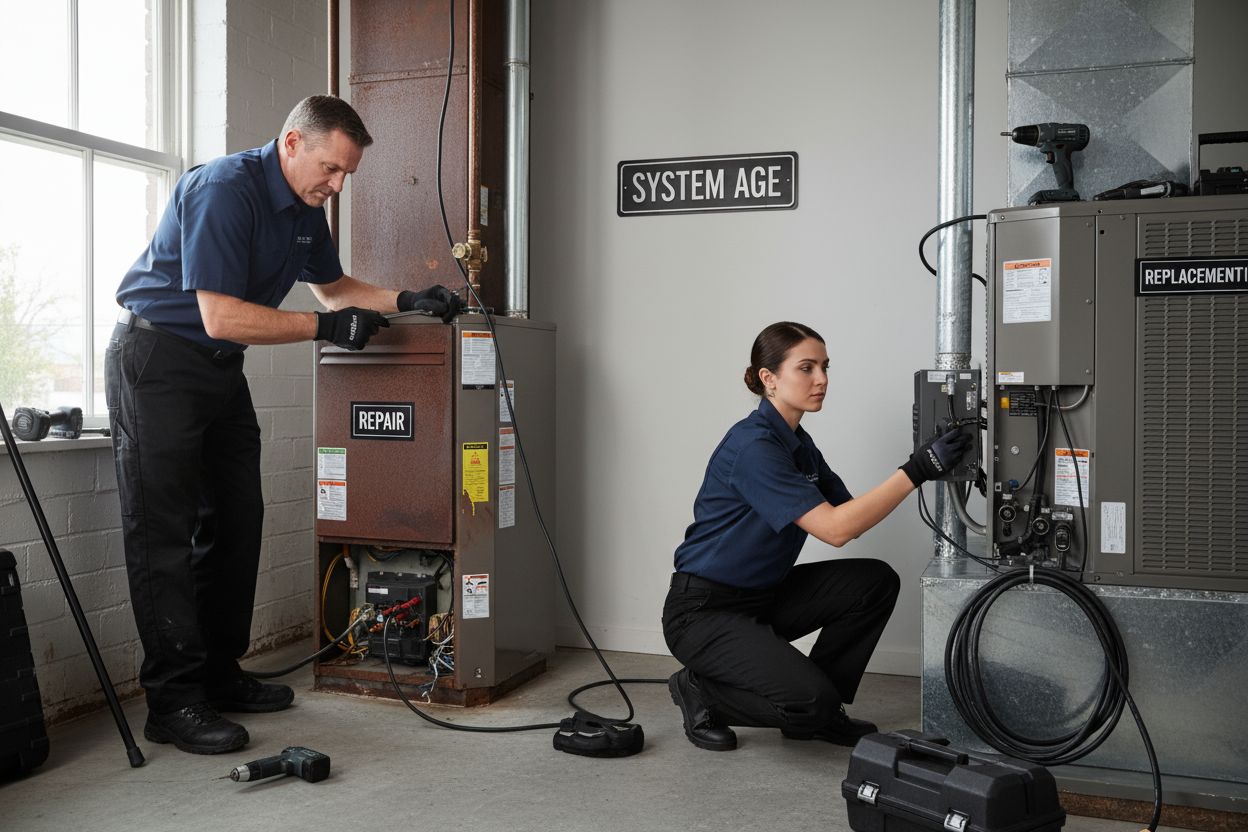
System age represents a fundamental determinant in HVAC decision making. Mechanical systems naturally deteriorate over time, experiencing progressive efficiency decline and increased vulnerability to component failures. Most HVAC systems have an expected functional lifespan of 10-15 years, after which performance degradation becomes increasingly pronounced. Older systems typically consume more energy, require more frequent repairs, and lack the advanced technological features of contemporary models.
Key age-related considerations include:
- Frequency of repair requirements
- Availability of replacement parts
- Compatibility with modern smart home technologies
- Original manufacturer warranty status
According to Energy.gov, systems over 10 years old are prime candidates for comprehensive replacement, especially when repair costs begin to accumulate.
Efficiency and Performance Metrics
Modern HVAC systems integrate advanced technological innovations that dramatically enhance operational efficiency. Contemporary units feature sophisticated design elements like improved compressor technology, variable-speed motors, and enhanced heat exchange mechanisms. These technological improvements translate directly into tangible benefits such as reduced energy consumption, more consistent temperature management, and superior indoor air quality.
Critical efficiency metrics to evaluate include:
- Seasonal Energy Efficiency Ratio (SEER) ratings
- Annual fuel utilization efficiency (AFUE)
- Energy consumption patterns
- Smart system integration capabilities
Learn more about understanding the difference between AC and HVAC systems to gain deeper insights into technological considerations that influence repair and replacement decisions. Ultimately, the most prudent approach involves a comprehensive assessment that balances immediate financial constraints with long-term performance expectations and technological advancements.
This table summarizes key factors that influence the decision to repair or replace, helping homeowners quickly compare cost, efficiency, and system age impacts.
| Factor | Relevance to Repair vs. Replace Decision |
|---|---|
| System Age | Older than 10-15 years often signals replacement; newer systems may be repairable |
| Frequency of Repairs | Frequent repairs indicate system decline and support replacement |
| Energy Efficiency | Lower efficiency favors replacement for energy savings; higher efficiency may justify repairs |
| Parts Availability | Hard-to-find parts can make replacement more practical |
| Warranty Status | Expired or limited warranty may influence replacement decision |
| Technological Features | Lack of modern features (smart integration, SEER ratings) supports considering replacement |
Understanding the Lifespan of HVAC Systems: Repair vs Replace
Comprehending the intricate lifecycle of HVAC systems requires a strategic approach that balances technical understanding with practical economic considerations. The lifespan of heating, ventilation, and air conditioning equipment is not a fixed metric but a dynamic continuum influenced by multiple interconnected factors.
Predictive Lifespan and Deterioration Patterns
HVAC systems are complex mechanical ecosystems that gradually decline in performance and reliability. Most residential and commercial systems have an expected functional duration ranging between 10 to 15 years, though this timeline can significantly vary based on maintenance practices, usage intensity, and environmental conditions. Critical components like compressors, heat exchangers, and electrical systems experience progressive wear that incrementally reduces overall system efficiency.
Key factors affecting system longevity include:
- Quality of initial equipment installation
- Frequency and thoroughness of professional maintenance
- Environmental stress and usage patterns
- Local climate and operational conditions
According to Energy.gov, proactive maintenance can extend HVAC system lifespans by up to 40%, potentially delaying costly replacements.
Diagnostic Indicators of System Health
Recognizing when an HVAC system approaches its functional limit requires careful evaluation of multiple performance indicators. Declining efficiency, increasing repair frequency, and escalating energy consumption serve as critical warning signals. Technicians assess system health through comprehensive diagnostic protocols that examine refrigerant levels, electrical connections, mechanical component integrity, and overall thermal performance.
Essential diagnostic considerations include:
- Unexplained increases in monthly energy expenditures
- Inconsistent temperature regulation
Explore our guide on extending the lifespan of your HVAC system to understand proactive strategies for maximizing equipment longevity. Ultimately, the decision between repair and replacement transcends simple age calculations, requiring a holistic assessment of system performance, financial implications, and future comfort requirements.
Real-World Scenarios: When to Repair and When to Replace
Deciding between HVAC repair and replacement involves intricate strategic considerations that extend beyond simple mechanical assessments. Real-world scenarios demand nuanced evaluation, balancing immediate financial constraints with long-term system performance and operational efficiency.
Economic Decision-Making Framework
Financial calculations form the critical foundation for HVAC system management decisions. Homeowners and business managers must conduct comprehensive cost-benefit analyses that consider not just immediate repair expenses, but projected long-term operational costs. The fundamental rule of thumb suggests that if repair costs exceed 50% of potential replacement expenses, system replacement becomes the more economically prudent choice.
Key economic considerations include:
- Total cumulative repair costs over recent years
- Projected energy efficiency improvements
- Potential tax credits or rebates for new installations
- Current system’s remaining functional capacity
Energy Star recommends evaluating repair versus replacement when systems reach approximately 10-15 years of operational service.
Performance and Reliability Assessment
Beyond pure financial calculations, performance metrics play a crucial role in determining whether repair or replacement represents the optimal strategy. Declining system reliability, inconsistent temperature management, and escalating energy consumption serve as critical warning indicators. Professional HVAC technicians conduct comprehensive diagnostic evaluations that assess multiple performance parameters, providing nuanced insights into system health.
Critical performance evaluation metrics include:
- Frequency of mechanical failures
- Refrigerant leak detection
- Electrical system integrity
- Overall thermal efficiency
Learn more about understanding HVAC maintenance to gain deeper insights into proactive system management strategies. The ultimate decision transcends simple numerical calculations, requiring a holistic understanding of technological performance, financial implications, and future comfort requirements.
Take Control of Your HVAC Decisions with Local Experts
Understanding when to repair or replace your HVAC system is more than a technical choice. It is about feeling secure in your home or business and not worrying about rising bills or unexpected breakdowns. If you are facing the challenge of constant repairs, rising energy costs, or aging equipment, you are not alone. Colley Refrigeration brings expertise in both heating and air conditioning solutions and long-term system care to Lake Jackson and surrounding Texas communities.

Do not let uncertainty impact your comfort or your budget. Contact the trusted local team with over 47 years of experience for transparent advice and reliable solutions. Get upfront pricing and prompt, professional service—available 24/7, so you always feel protected. Ready for clarity and peace of mind? Visit Colley Refrigeration or explore our HVAC maintenance tips to schedule your service or request an estimate now. The right choice for your comfort is just a conversation away.
Frequently Asked Questions
What are the main differences between HVAC repair and replacement?
HVAC repair focuses on fixing specific components or localized issues to restore system functionality. In contrast, replacement involves installing a completely new system when repairs become too frequent or costly. Assess your system’s age and history to decide the best option for your situation.
How do I determine if I should repair or replace my HVAC system?
If repair costs exceed 50% of the potential replacement costs, it’s often more economical to replace the system. Evaluate your recent repair expenses and overall system performance to make an informed decision.
What age indicates that HVAC replacement is necessary?
Most HVAC systems should be replaced after 10-15 years, as efficiency typically declines and repair needs increase significantly. Check the age of your system, and if it’s nearing this range, consider scheduling an assessment.
How can I assess the efficiency of my current HVAC system?
Look at metrics such as the Seasonal Energy Efficiency Ratio (SEER) and the frequency of mechanical failures. If your system has a SEER rating below 14 or is requiring repairs every few months, it may be time to consider a replacement.
What factors should I consider when analyzing repair costs?
Consider the total repair costs over the past two years, energy bills, and any potential savings from a new, more efficient system. Track these expenses over time to understand the financial impact of continuing repairs versus a new installation.
How can maintenance affect the lifespan of my HVAC system?
Routine maintenance can potentially extend the lifespan of your HVAC system by up to 40%. Schedule regular check-ups to ensure optimal performance and delay costly replacements.
Recommended
- The Importance of Preventative Maintenance for HVAC Systems – Colley Refrigeration
- Understanding Why Schedule HVAC Maintenance Matters – Colley Refrigeration
- Understanding the Difference Between AC and HVAC – Colley Refrigeration
- Understanding Air Condition Maintenance for Homes and Businesses – Colley Refrigeration